

|
ANWR's legacy began back in 1953 with a Sierra Club
Bulletin article entitled "Northeast
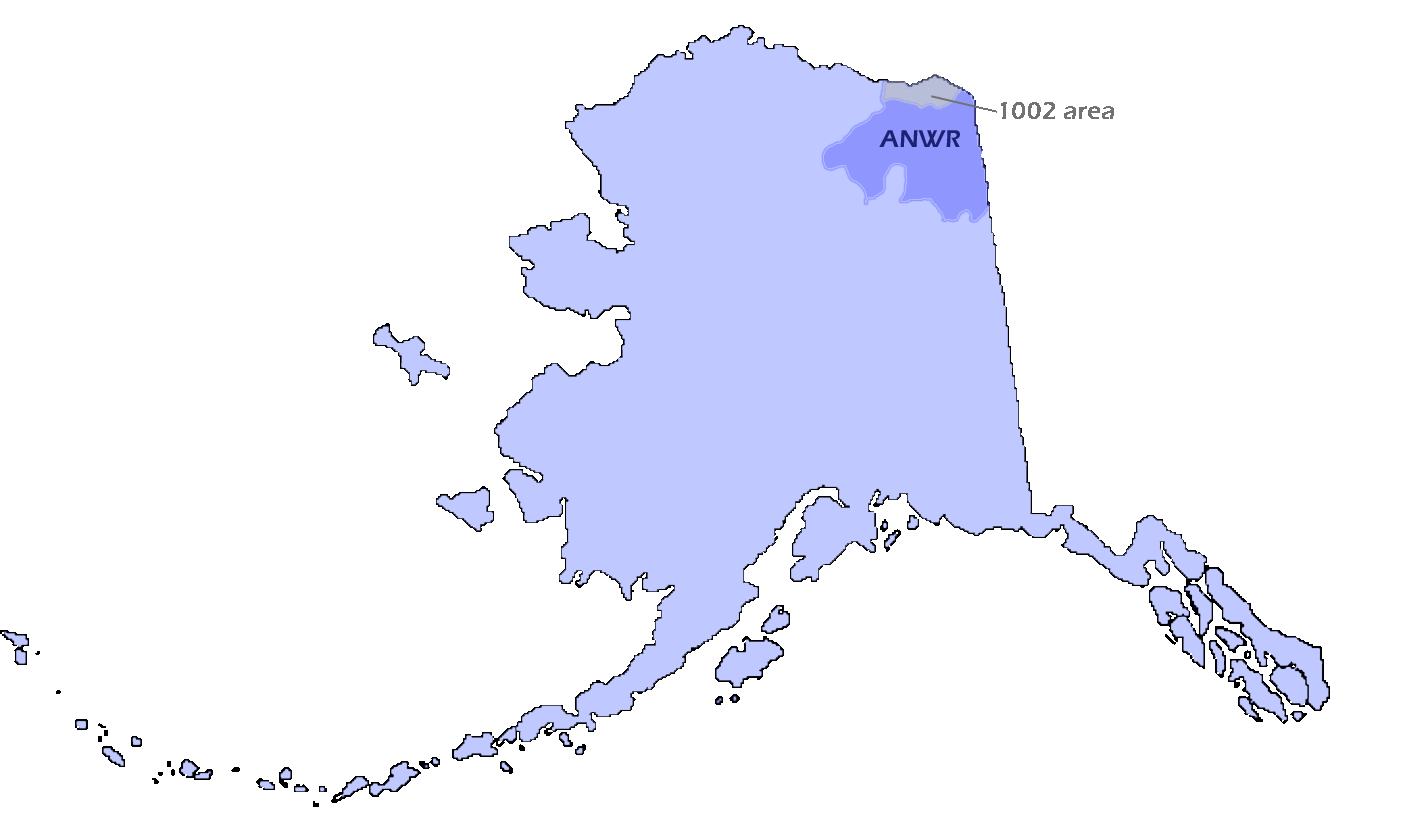
Seismic data was gathered throughout the 1980's. In 1987, the Department of Interior filed their final report recommending that the coastal plains be opened for development. However, this report was overshadowed by the Exxon Valdez accident in 1989, which spilled 11 million gallons of crude oil into Prince William Sound, an accident whose effects can still be seen today. Since then, legislation to open area 1002 has poked its head up multiple times. In 1991, it was dropped from the National Energy Policy Act. Then in 1995, being opposed to oil development in ANWR President Clinton vetoed a bill that would have allowed drilling. As he stated, "I want to protect this biologically rich wilderness permanently." Of course the story did not end there. In 1998, the US Geological Survey went back to its seismic data collected in the 80's as well as gathered new data and analyzed it with more current technology and understanding of oil geology. Their calculations claim there would be no economically recoverable oil at $13 per barrel and between 3 to 10.4 billion barrels of of economically recoverable oil at $30 per barrel. Currently, a barrel of oil costs between $32-$38. Furthermore, they estimate the 85% of ANWR's oil is in the northwest region of the 1002 area, closest to existing oil development. To create perspective, the US produces about 3 billion barrels of oil per year and consumes about 7 billion barrels. In the wake of 9/11 President Bush has been calling for drilling in ANWR, saying that we need to minimize our reliance of foreign oil. A 2002 initiative to open 2000 acres in ANWR to drilling passed the House but not the Senate. It was left out of the 2003 Energy Bill, however, as a way to ensure the passing of other measures (drilling in the Rockies, GUlf of Mexico, and western Alaska). So here we are in 2004 with politicians, conservationists, developers, and citizens all unsure of what will become of ANWR. |


|
Contents
Home Background History Timeline Photos The Debate List of Terms Links References |
 Arctic: The Last Great Wilderness." National Park Service planner
George Collins and biologist Lowell Sumner wrote the article. Later,
conservationists Olaus and Mardy Murie joined their ranks to form the core
people for the campaign to preserve the area that is known today as ANWR.
Through their efforts, thousands of people, groups and individuals alike,
were called to action. In the end, their campaign was successful.
By executive order of President Eisenhower and under Public Land Order 2214,
the creation of the 8.9 million acre Arctic National Wildlife Range took
place in 1960.
Arctic: The Last Great Wilderness." National Park Service planner
George Collins and biologist Lowell Sumner wrote the article. Later,
conservationists Olaus and Mardy Murie joined their ranks to form the core
people for the campaign to preserve the area that is known today as ANWR.
Through their efforts, thousands of people, groups and individuals alike,
were called to action. In the end, their campaign was successful.
By executive order of President Eisenhower and under Public Land Order 2214,
the creation of the 8.9 million acre Arctic National Wildlife Range took
place in 1960.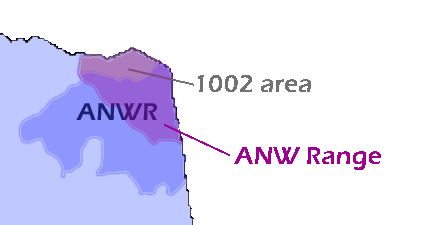 Later,
in 1980, the Alaska National Interest Lands Conservation Act (also know as
the Alaska Lands Act or ANILCA) was passed by Congress. The version
that was passed by the House of Representatives would have designated the
entire range as Wilderness. However, it was not to be. Though,
the Senate did pass the legislation, they did not include the coastal plains
region in the Wilderness designation. Instead, they called for further
studies of petroleum potential under Section 1002 of the act, which is how
the area got its name--the 1002 (ten-oh-two) area. It was this
provision that marked the beginning of today's debate--should we or
shouldn't we open up the 1002 area for development? When the act was
signed into law by President Carter, it increased the size of
Later,
in 1980, the Alaska National Interest Lands Conservation Act (also know as
the Alaska Lands Act or ANILCA) was passed by Congress. The version
that was passed by the House of Representatives would have designated the
entire range as Wilderness. However, it was not to be. Though,
the Senate did pass the legislation, they did not include the coastal plains
region in the Wilderness designation. Instead, they called for further
studies of petroleum potential under Section 1002 of the act, which is how
the area got its name--the 1002 (ten-oh-two) area. It was this
provision that marked the beginning of today's debate--should we or
shouldn't we open up the 1002 area for development? When the act was
signed into law by President Carter, it increased the size of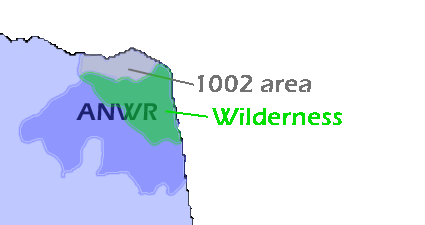 the range to 19.5 million acres and renamed it a "Refuge." It also
designated all of the original range--minus the 1002 area--as Wilderness.
Even with the provision that the 1002 area was to be studied, it was at
least safe for the immediate time. Section 1003 of ANILCA prevents oil development in the disputed area until approved by Congress.
the range to 19.5 million acres and renamed it a "Refuge." It also
designated all of the original range--minus the 1002 area--as Wilderness.
Even with the provision that the 1002 area was to be studied, it was at
least safe for the immediate time. Section 1003 of ANILCA prevents oil development in the disputed area until approved by Congress.